In a world designed to keep us constantly scrolling, clicking, and responding, our most valuable professional asset, which is our attention, is under siege. We have entered a "distraction economy" where the ability to focus is becoming increasingly rare, and at the exact moment is becoming most valuable.
This article explores the transformative concept of Deep Work, a term coined by Georgetown University computer science professor Cal Newport. By understanding the psychology of focus and implementing structured rules, you can move away from the "busyness" of modern work toward true, high-impact productivity.
What is deep work?
Cal Newport defines Deep Work as:
"Professional activities performed in a state of distraction-free concentration that push your cognitive capabilities to their limit. These efforts create new value, improve your skill, and are hard to replicate."
Deep work isn't just a productivity "hack"; deep work in psychology is a neurological necessity for quality performance. To understand why, we must look at two scientific concepts:
- Attention Residue: Research by Sophie Leroy shows that when you switch from Task A to Task B, a "residue" of your attention stays stuck on the first task. If you check your email during a writing session, your brain remains divided for up to 23 minutes, significantly lowering your cognitive capacity.
- Myelination: When you focus intensely on a single skill without distraction, your brain triggers a process called myelination. This strengthens the connections between neurons, allowing information to fire faster and more cleanly. Essentially, deep work literally rewires your brain to help you learn hard things faster.
Deep vs. shallow work
To truly master high-level focus, you first need to understand its biggest enemy: Shallow Work.
What is shallow work?
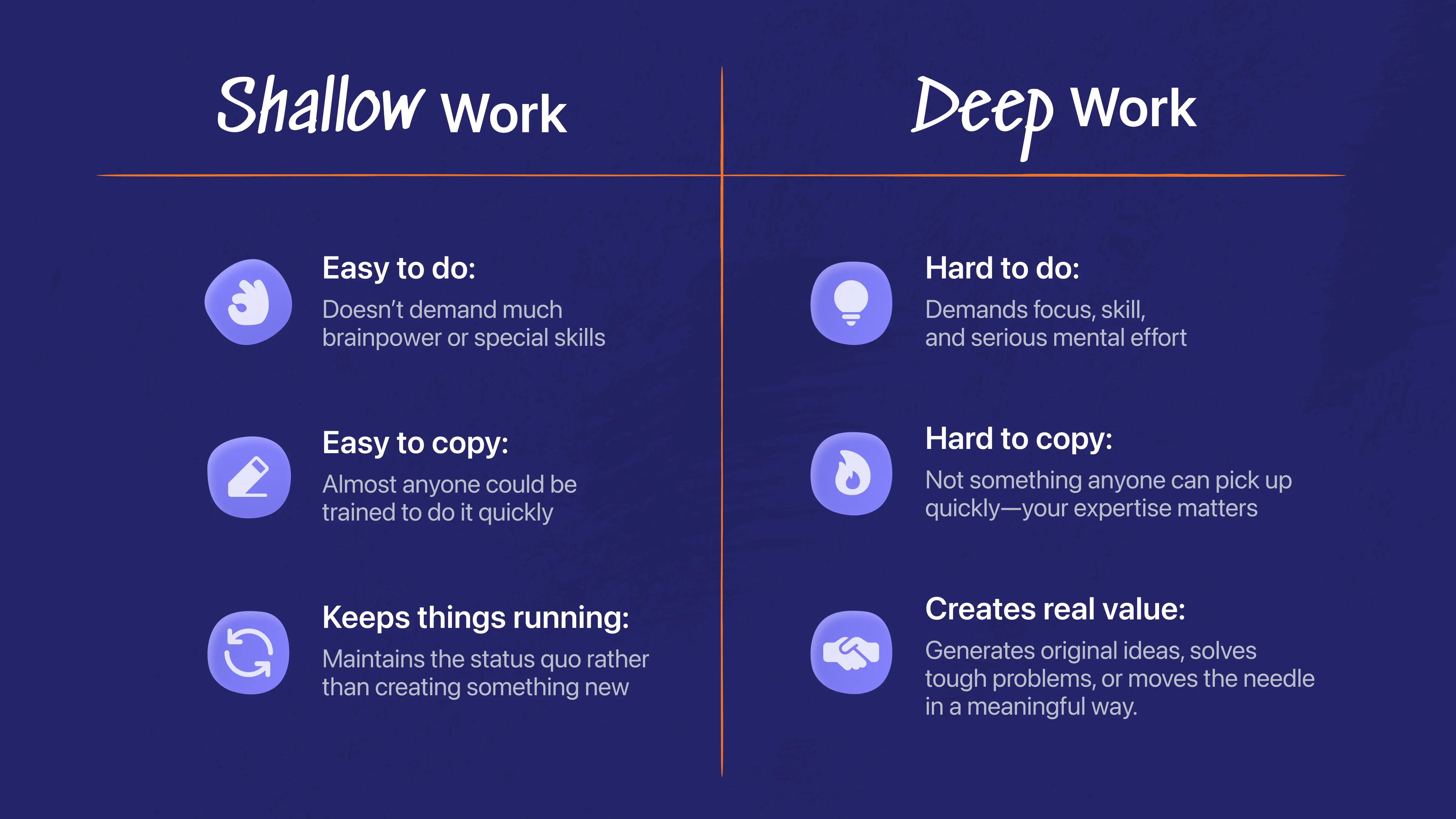
Think of shallow work as the "busywork" that keeps your day moving but doesn't actually do much for your big goals. These are tasks that:
- Are easy to do: They don’t require intense brainpower or specialized skills.
- Are easy to copy: Almost anyone could be trained to do them quickly.
- Don't create "new" value: They keep things running rather than creating something original or solving a hard problem.
Common examples include:
- Refreshing your inbox and sending quick replies.
- Sitting through "status update" meetings where everyone just recites what they did yesterday.
- Filling out expense reports or basic data entry.
- Scrolling through Slack or Teams just to stay "visible."
Cal Newport argues that many of us have accidentally turned into "human network routers." Just like a piece of internet hardware, a router doesn't create information; it just moves it from point A to point B. When you spend your entire day forwarding emails, sitting in meetings to pass along info, and responding to pings, you aren't actually "working" in a way that uses your unique talents.
The danger of shallow work
The problem isn't that shallow work is "bad": most jobs require some of it to function. The danger is that shallow work is addictive. It feels productive because you’re checking things off a list, but it leaves you "distracted from distraction." If you spend 100% of your energy being a router, you’ll never have the mental space to be a creator.
Cal Newport’s 4 core rules
Cal Newport’s system helps you protect your brainpower and take back control of your time. Here are his four simple rules for getting more done:
Rule #1: Make focus a habit
Don’t wait for "the right mood" to work. Instead, pick a schedule that works for you:
- The "All-In" Way: Cut out all distractions and focus on one big goal for days at a time.
- The "Split" Way: Divide your week. Spend some days on deep work and others on small chores (like 4 days of big projects, 3 days of maintanence).
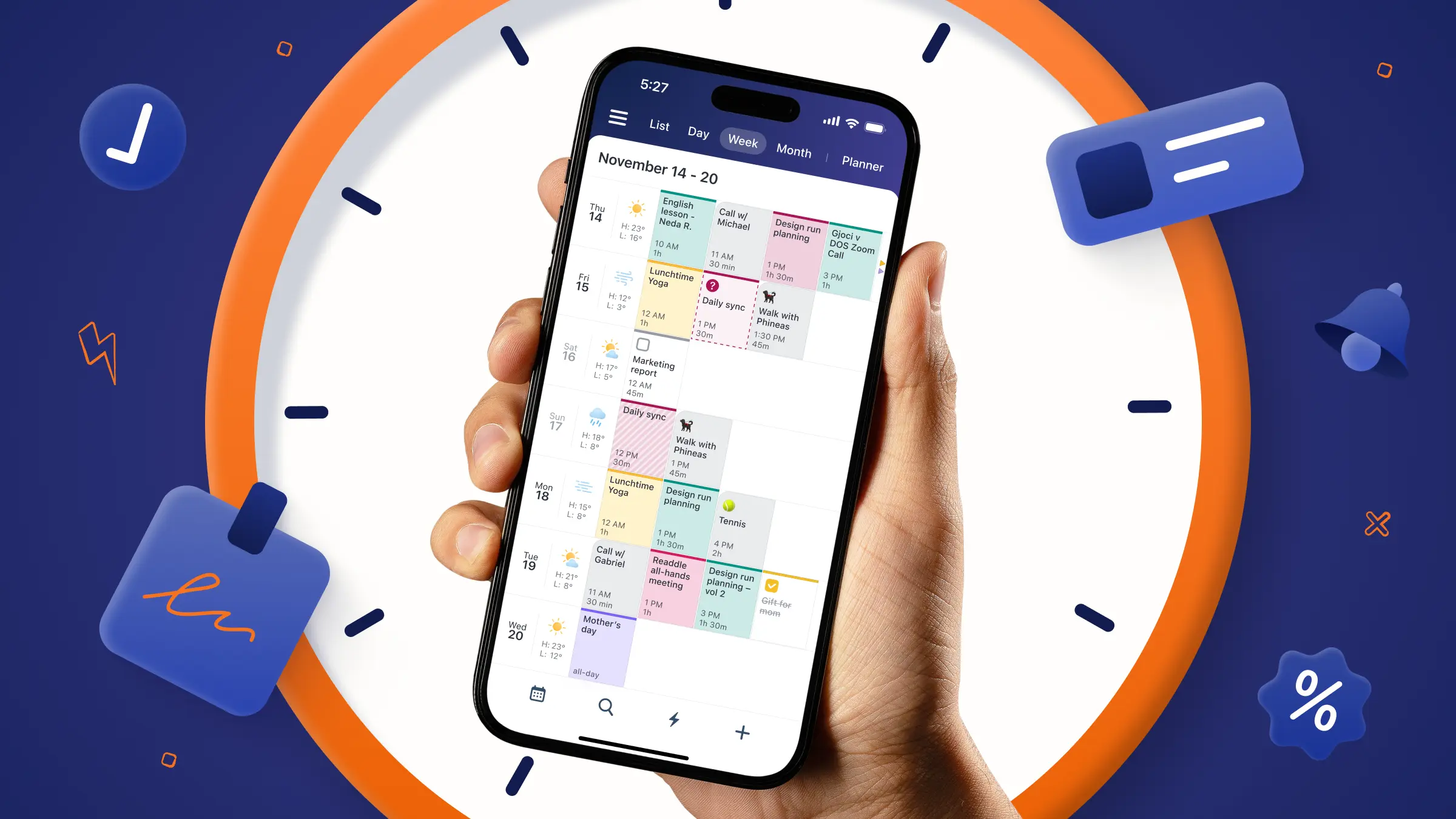
- The "Daily" Way: Pick the same time every day to focus, like 8:00 AM to 10:00 AM, to build a rhythm. For this, you can use an app like Calendars by Readdle and create recurring events.
- The "Quick Switch" Way: Jump into deep focus whenever you find a free 30-minute gap.
Rule #2: Get comfortable being bored
If you grab your phone the second you feel bored, you are training your brain to need constant distraction. To focus better, you must teach your mind to be still. Try "Productive Meditation": think about a specific work problem while doing something physical, like walking, driving, or washing dishes. You can incorporate these as habits and check the progress via the Habit Tracker in Calendars.
Rule #3: Be picky with social media
Don't use an app just because it has some benefit. Ask yourself: "Does this app actually help me reach my biggest goals?" If an app distracts you more than it helps you, it’s time to delete it. Use technology like a craftsman uses a tool: only if it’s truly necessary for your best work.
Rule #4: Cut out the "busy work"
Identify and limit "shallow work": these are tasks that take time but don't create much value, like endless emails or minor chores.
- Set a limit: Decide exactly how much time you'll allow for small tasks each day.
- The hard stop: Pick a time to stop working (like 5:30 PM) and stick to it. This "fixed schedule" forces you to focus on what actually matters during the day.
To help you bridge the gap between theory and action, here is a list of real-world deep work examples and a step-by-step guide on how to apply these methods as a student or professional.
Real-world deep work examples
To help you bridge the gap between theory and action, here is a list of real-world deep work examples:
- Coding & engineering: A software developer spends 4 hours without Slack or email to architect a new database schema. By avoiding "context switching," they solve in one morning what usually takes a week of fragmented afternoons.
- Academic research: A student spends a 90-minute block reading and annotating a complex scientific paper. Instead of just "reading," they are building a mental model of the study’s data, which Newport calls a "cognitively demanding task."
- Creative strategy: A marketing manager spends two hours on a Tuesday morning (before checking any messages) drafting a brand's yearly strategy. They use this time to connect "big ideas" that they otherwise wouldn't see while distracted by daily pings.
- The "Grand Gesture" (Bill Gates): Gates famously takes "Think Weeks" twice a year. He retreats to a cabin with a stack of papers and no internet to think about the future of Microsoft. For a student, this could be going to a different city's library for a weekend to finish a thesis.
The deep work study method: A guide for students
If you are a student, your goal is to learn hard things quickly. So, what is deep work for students?
Use this structured approach to transform your study sessions - Calendars by Readdle could be your best companion in this journey:
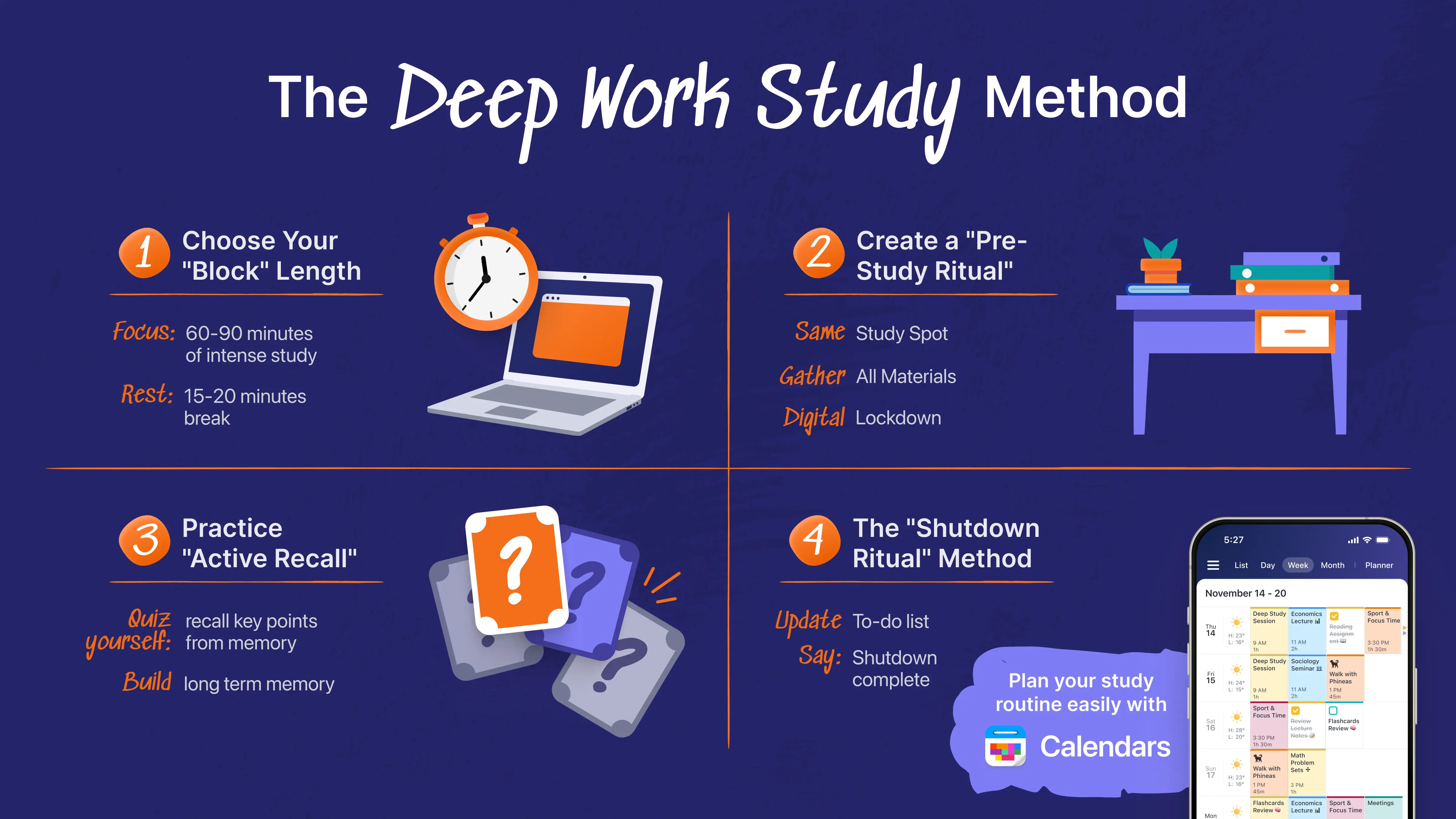
1. Choose Your "block" length
Newport suggests that the upper limit for deep work is about 4 hours per day. For students, the most effective cycle is often the 90-minute block.
- Focus: 60-90 minutes of intense, single-task work. Schedule a time block for this in Calendars.
- Rest: 15-20 minutes of "low-stimulation" rest (walking, staring out a window). A method like timeboxing would work great in this case - it will help you assign a fixed amount of time to a task, activity or rest in advance.
2. Create a "pre-study ritual"
Don't just start; signal to your brain that it's time to work.
- Location: Always study in the same "deep work spot" (e.g., a specific desk in the library).
- Materials: Gather everything you need (water, books, laptop) before you start so you don’t have an excuse to get up.
- Digital Lockdown: Put your phone in another room or turn it completely off.
3. Practice "active recall" during the session
Deep work for students is most effective when combined with active testing.
- Don't just re-read: Spend 15 minutes of your block trying to write down everything you remember from a chapter without looking at your notes. This "productive struggle" is what builds long-term memory.
4. The "shutdown ritual"
At the end of your study day, follow a set routine to tell your brain work is over.
- Update your to-do list: Write down exactly where you left off. You can do so quickly by using Planner in Calendars.
- Say a phrase: Newport literally says, "Shutdown complete." This prevents "attention residue" (thinking about your math homework while trying to sleep).
A 5-step deep work plan for Calendars
Here is a simple, 5-step flow to set up a Deep Work Plan using the features in Calendars by Readdle. This method helps you stop reacting to notifications and start controlling your output.
Step 1: Pick your "wildly important" goal
Before you look at your calendar, decide on one big thing you want to achieve this week.
- Create a new task and title it "WIG: [Your Goal]."
- Newport suggests focusing on the "Wildly Important" so you don’t get distracted by a hundred tiny, unimportant chores.

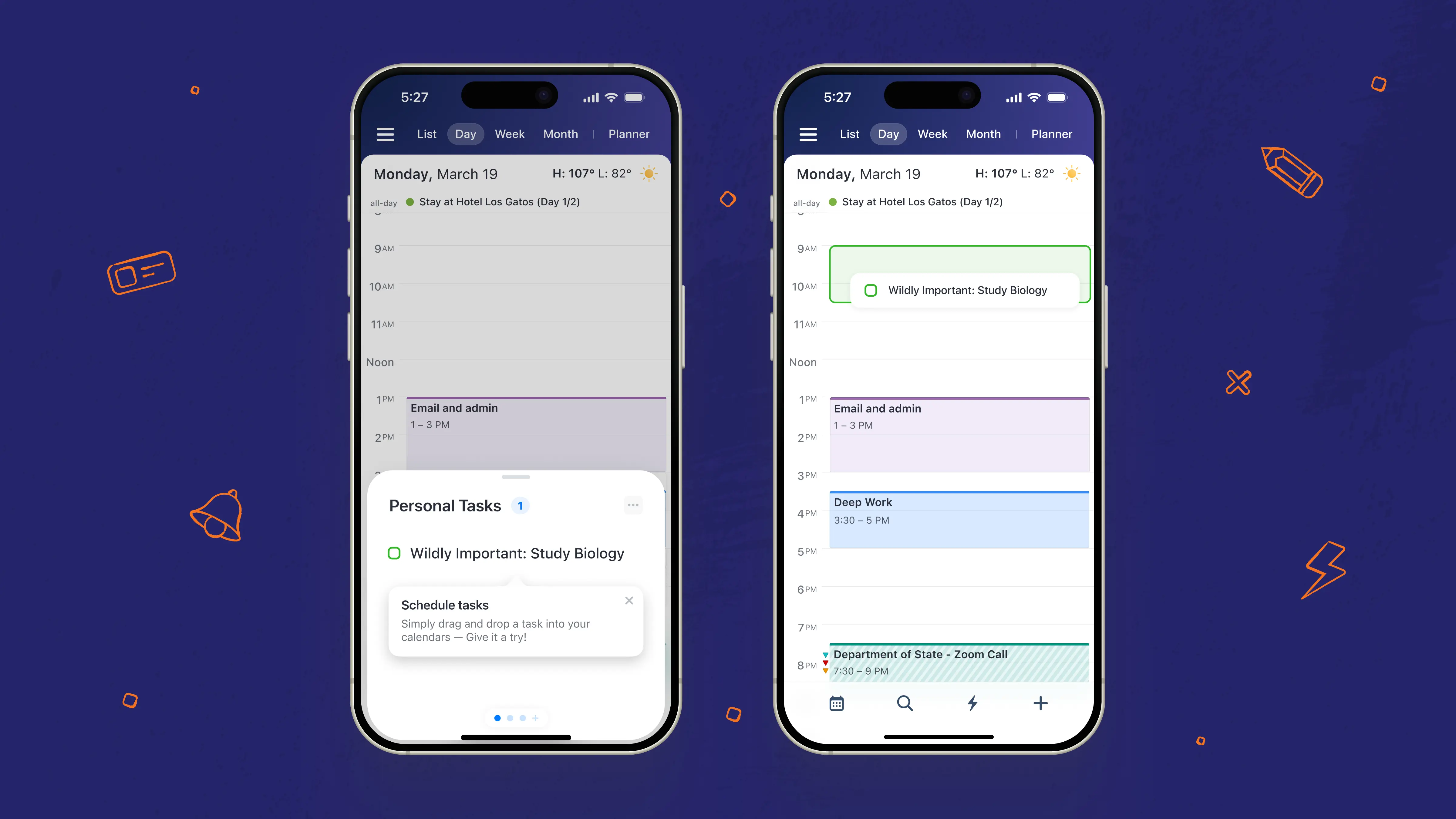
Step 2: Drag & drop your focus blocks
Calendars by Readdle allows you to see your tasks and calendar on one screen.
- Drag your task from the task list directly onto your calendar.
- Aim for a 90-minute block in the morning when your brain is freshest.
- Set these blocks as "Busy" so others can't invite you to meetings during this time.
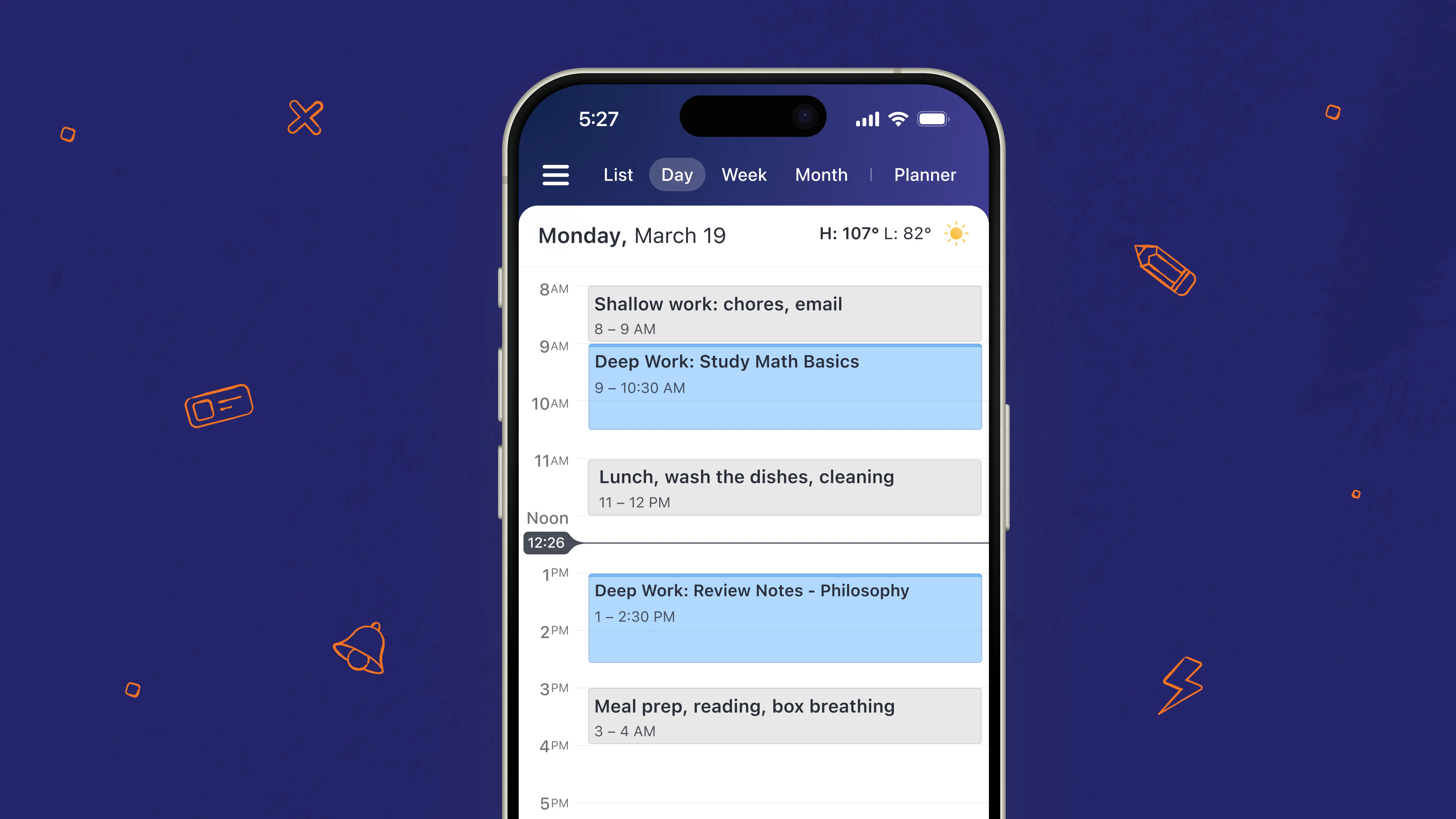
Step 3: Color-code for depth
Visual cues help your brain switch modes.
- Assign a specific, bold color (like Deep Blue) to all Deep Work sessions. Use a lighter, neutral color (like Grey) for Shallow Work.
- When you look at your week, you should immediately see a "rhythm" of blue blocks. If the calendar is all grey, you are spending too much time on busy work.
Step 4: Batch your shallow work
Instead of checking email 50 times a day, group it.
- Create two recurring 30-minute events titled "Admin/Email Batch."
- Place these after your Deep Work blocks (e.g., at 11:30 AM and 4:00 PM).
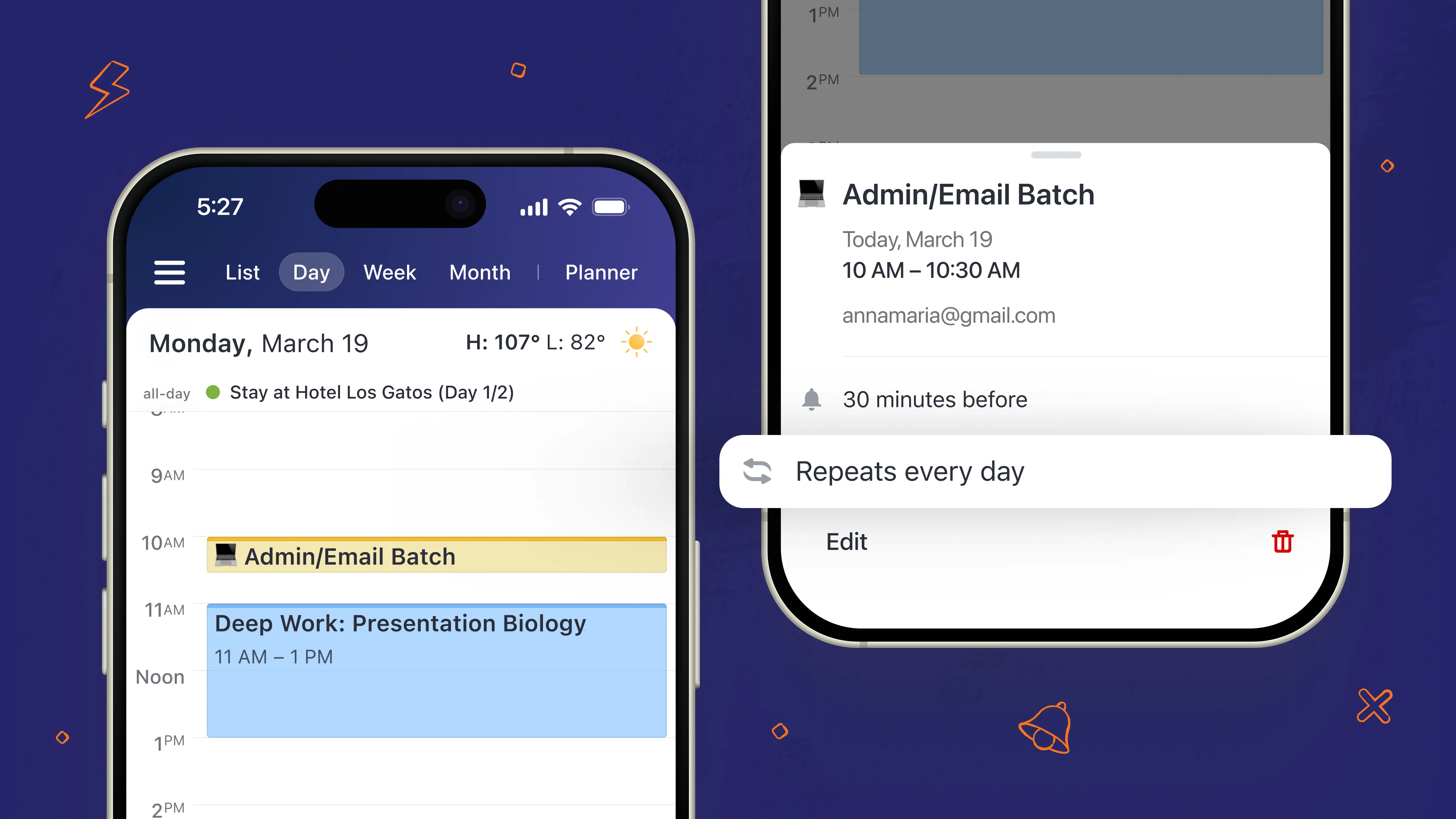
This prevents "attention residue" from ruining your concentration.
Step 5: The Friday scoreboard
To get better at deep work, you need to track your progress.
- Create a recurring event every Friday at 4:00 PM titled "Weekly Review & Scoreboard."
- Look at your "Deep Blue" blocks. How many did you actually complete?
- Write down the total hours of deep work finished this week in the event notes.
- Once finished, clear your task list for next week and mentally tell yourself, "Shutdown complete."
Use the "Planner" view on iPad or Mac to see your tasks and week side-by-side. This makes it much easier to time block your entire day, which Newport recommends as the best way to be intentional with your time.
FAQ
Are there any benefits of using deep work for students?
There are actually some science-backed benefits for students that use the deep work study method:
- Better Grades: A 2025 study found that students in phone-free environments performed significantly better on exams, particularly in subjects requiring critical thinking like Math and English.
- Faster Learning: By focusing on one task, your brain undergoes myelination, which coats your neural pathways in a layer of "insulation," allowing signals to travel faster. You aren't just getting smarter; you're making your brain more efficient.
- The 75/33 Rule: Recent 2026 data on high achievers suggests that a rhythm of 75 minutes of work followed by 33 minutes of rest is emerging as a new "sweet spot" for hybrid and office-based workers to avoid burnout while maintaining high output.
Are there any additional resources on this topic?
You can explore the following studies and resources:
- The 23-Minute Distraction Study (University of California)
- Deliberate Practice Research (Anders Ericsson)
- The 4 Disciplines of Execution
- The "Deep Questions" Podcast
Where do I find Cal Newport’s book?
If you want to dive deeper into these strategies and learn what is Deep Work book about instead of searching for Deep Work summary PDFs, use these legitimate methods to read Deep Work: Rules for Focused Success in a Distracted World:
- Local Libraries: Use apps like Libby or OverDrive to borrow the e-book or audiobook for free using your library card.
- Legitimate Retailers: Purchase a copy via IndieBound, Bookshop.org, or Amazon.
- University Access: If you are a student, check your university's digital repository or physical library stacks.
What are the 4 rules of deep work?
Based on Cal Newport’s framework, here are the official names of the 4 Core Rules:
- Work Deeply
- Embrace Boredom
- Quit Social Media
- Drain the Shallows
How many hours is deep work? Can we really do deep work for more than 6 hours a day?
For most people, the limit for true, high-intensity focus is about 4 hours per day. Beginners usually start with 1 hour of focus before their brain feels tired.
Those who have practiced for years (like professional writers or elite coders) can push this to 4 hours.
Can we do more than 6 hours?
In short: No. Not at peak quality.
While you might sit at your desk for 8 hours, the "deep" part of your work, where you are solving the hardest problems, usually starts to fade after 4 hours.