The clocks go back this Sunday, October 25, across many countries in Europe, and on the 1st of November in the US. With everyone resetting their clocks, it felt like a good moment to share something strange we came across about how time changes affect us.
Most people will treat the clocks changing as a minor inconvenience: an extra hour of sleep, a microwave clock to reset, maybe a joke about how the dog still wants dinner at the old time. Enjoy it. Because the change that really affects us isn’t this one. It’s the one in March, when the clocks jump forward and an hour simply goes missing.
The Monday after it is, year after year, one of the hardest days of the year on the human body. And yet, by every meeting dataset we could find, your calendar treats it like any other Monday.
The hour that disappears
Sometime in the early hours of a Sunday in March, the clock does something it never does the rest of the year. It doesn’t tick forward. It skips. One minute it’s 1:59, the next it’s 3:00, and that hour just never happens.
Most of us shrug it off. We grumble about it over coffee, maybe show up a little groggy, and by Tuesday we’ve forgotten all about it. Our bodies, however, don’t forget quite so fast.
If we lose an hour of sleep over the weekend and walk straight into a full workweek, Monday looks different. Researchers have spotted it from some unexpected places: emergency room admissions, workplace injury reports, even how much time people spend browsing the internet when they should be working.
What the change of the clocks could do to the heart
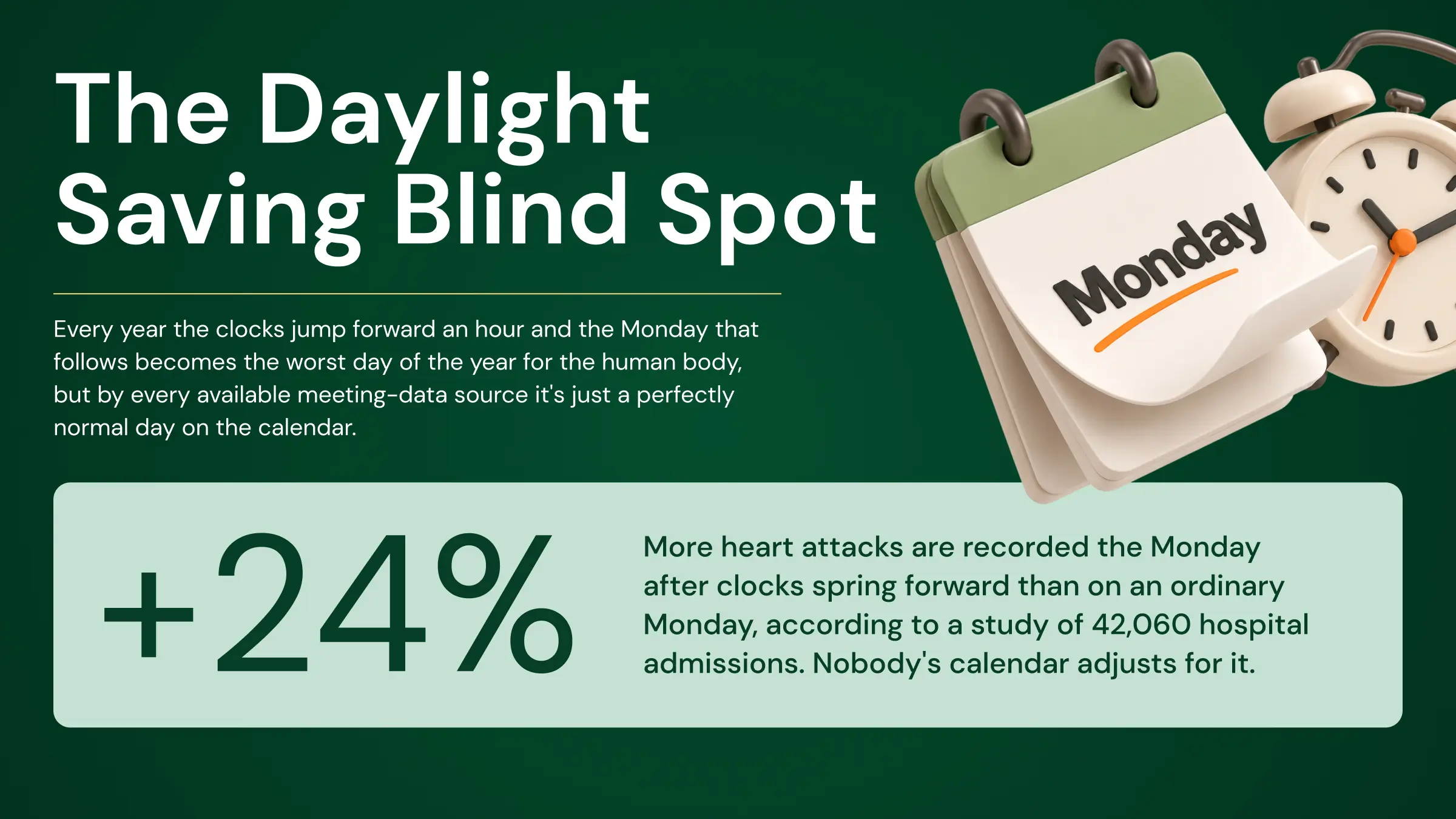
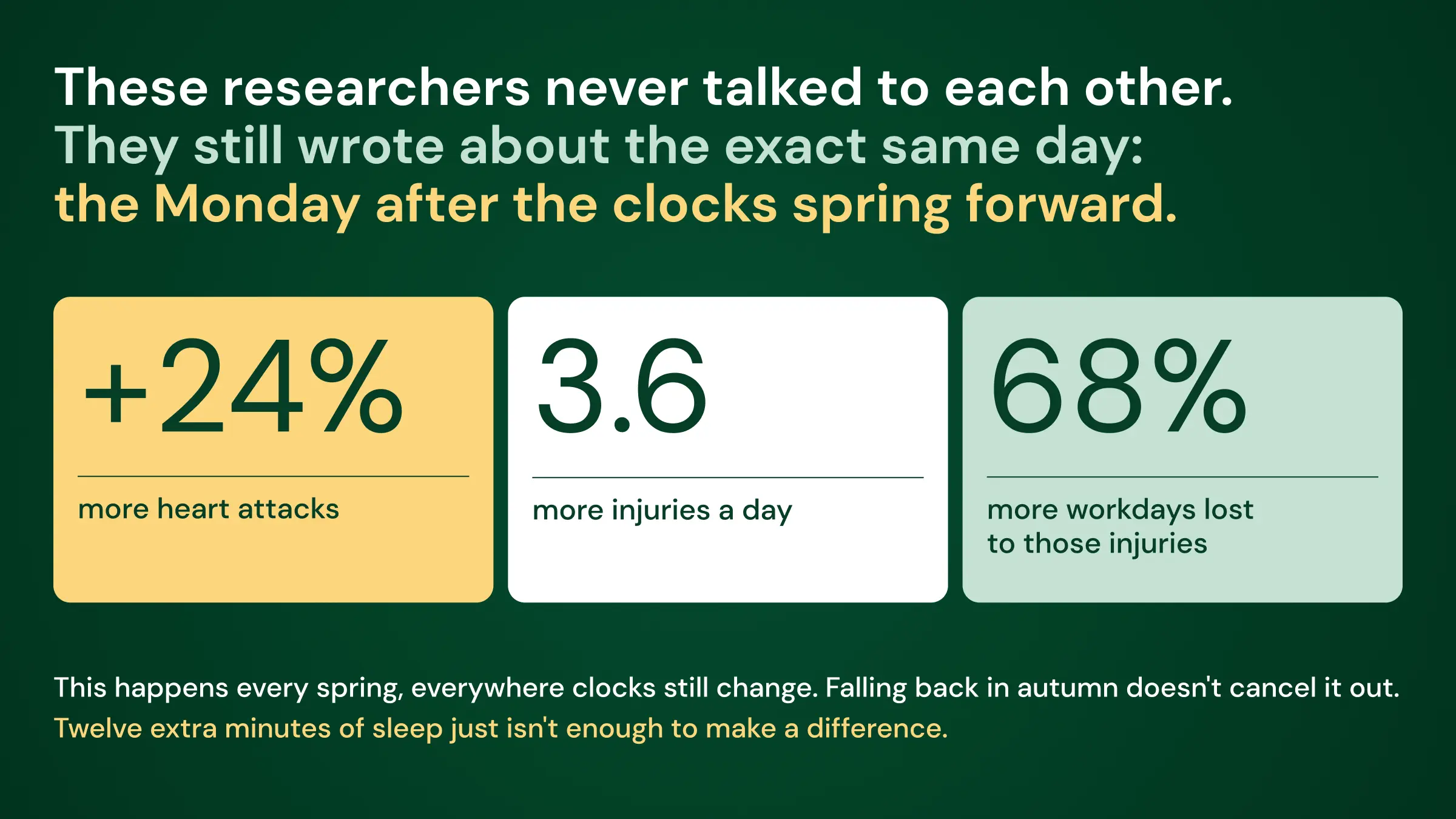
The strongest evidence comes from a 2014 study built on 42,060 hospital admissions for heart attacks requiring emergency treatment, pulled from a Michigan cardiovascular database between 2010 and 2013. Heart attacks rose 24% the Monday after spring-forward, compared with an ordinary Monday. They fell 21% the Tuesday after fall-back.
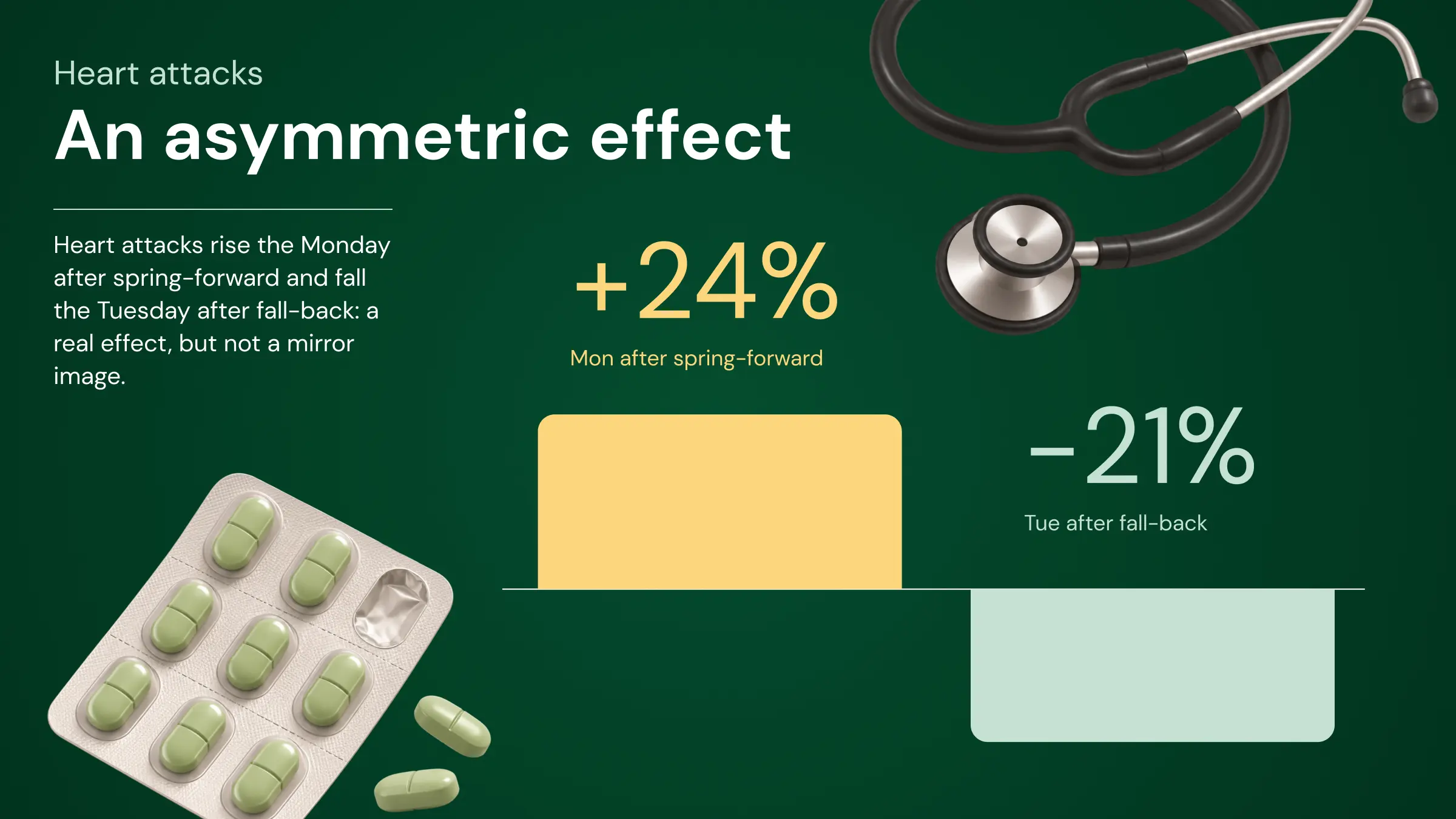
At first that looks like a tidy trade: lose an hour, pay for it; get an hour back, cash in. The researchers who ran the study weren't willing to go that far. Their read was that the time change probably speeds up heart attacks that were coming anyway, in people who were already at risk, rather than creating new ones out of nothing. Which matters, because it makes this a real and repeated pattern rather than a prediction about any one person's Monday. And once you look past hospital admissions, the fall side of the ledger turns out to be much weaker than the spring side.
The time change injury spike
A completely different line of research, with no connection to hospitals or cardiology, tells a similar story from an unexpected angle: workplace safety.
The American Psychological Association pulled 24 years of US federal mine-safety injury records, 1983 through 2006, and found that on the Monday after spring-forward, the average worker sleeps about 40 minutes less, and mines report 3.6 more injuries than usual. Those extra injuries also tend to be worse. The data shows a 68% jump in the number of workdays lost to them that day.
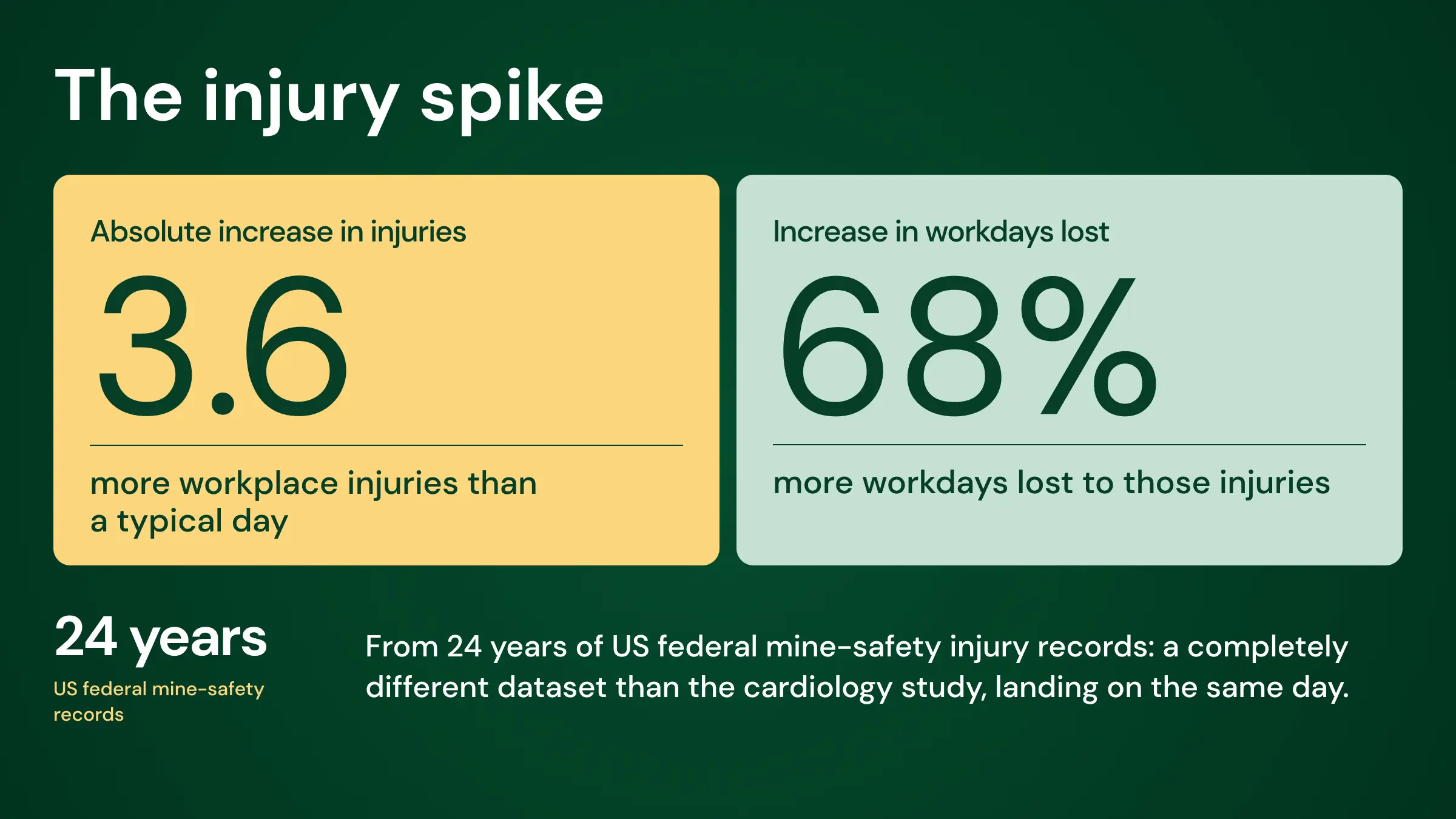
"One hour of lost sleep may not seem like a lot. But our findings suggest it could have an impact on people's ability to stay alert on the job and prevent serious injuries," said lead researcher Christopher Barnes. He and his co-author went further, suggesting organizations "schedule particularly dangerous work on other days" right after the clocks change.
Autumn barely shows up in the same numbers. Fall-back hands people back roughly 12 minutes of sleep, which isn't much, and apparently isn't enough to change anyone's odds of getting hurt on the job.
The same two researchers later asked a smaller, harder question: even without an injury to show for it, does anyone actually work worse that Monday?
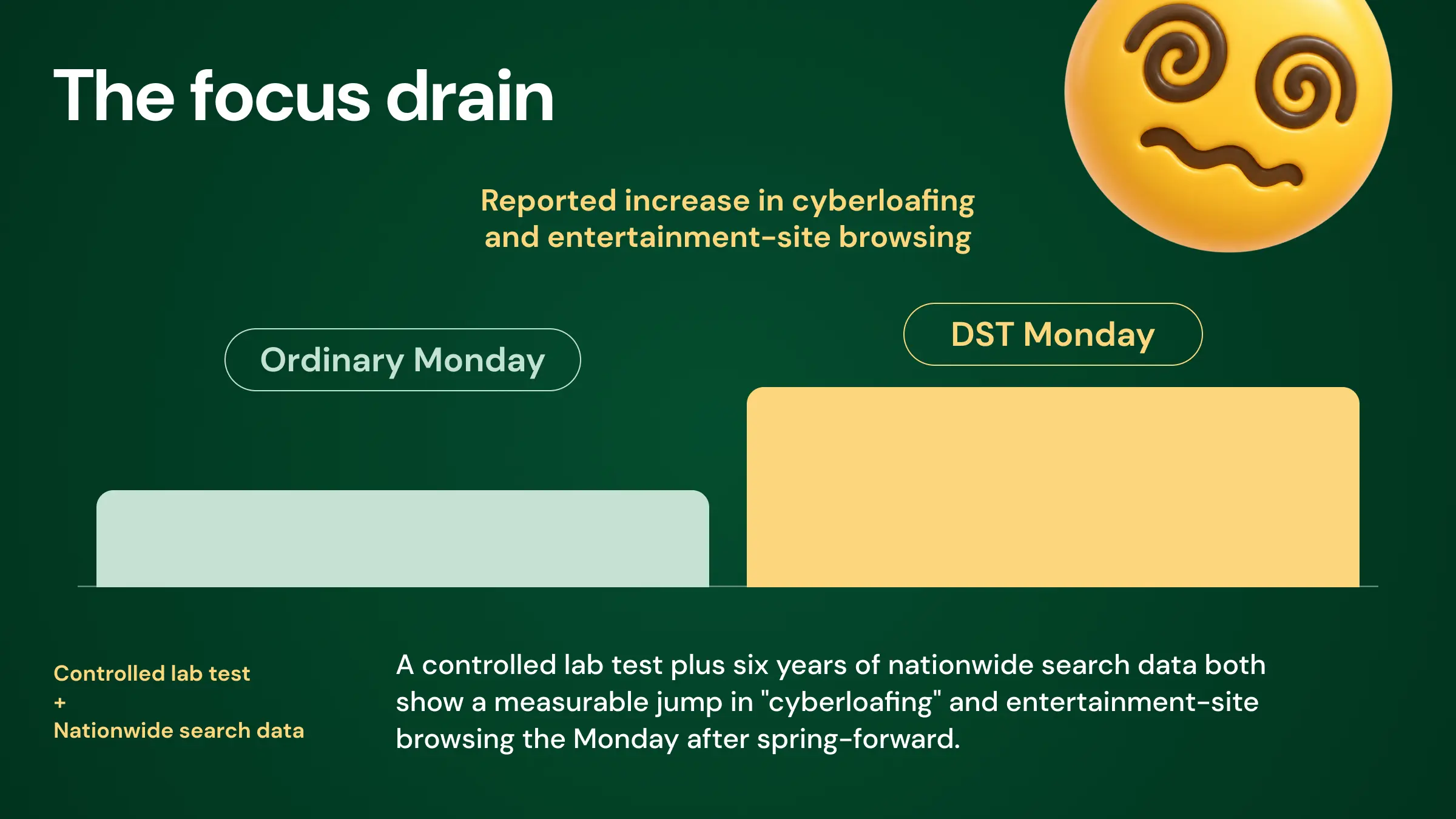
Using a lab study paired with six years of nationwide search data, they found that sleep-deprived people spent more time on non-work browsing, and that searches for entertainment sites spiked nationwide the Monday after spring-forward. No injury report captures a day like that. But it's the same pattern turning up again, in a completely different kind of data: less sleep, worse focus, on a day nobody marked as different.
Meanwhile, your calendar continues on as if nothing has happened
If Monday were already a slow day on the calendar, none of this would matter as much.
However, it isn't. Supernormal looked at 50.9 million meeting-hours and found Tuesday busiest, Friday quietest, with Monday and Wednesday running close behind Tuesday rather than trailing off. Microsoft's own research found almost the same data independently: Tuesday busiest, Friday quietest, nothing suggesting Monday lets up.
Neither company set out to study this specific Monday. They were just describing an average week. But that's sort of the point: in an average week, across two unrelated datasets, nothing about the Monday after the clocks change gets treated as different. No lighter load, no fewer calls, no built-in grace period. Whatever the human cost of that lost hour is, the calendar has no idea it exists.
Building in the Monday your calendar won't
This isn't a pitch for dreading daylight saving time, or panicking over one lost hour. It's more that the calendar most of us live inside was never built to account for any of this, and maybe it should be. Nothing marks the Monday after the clocks change as different from any other Monday. The data says maybe it ought to.
You can't move the sun back, and your 9 am probably isn't moving either. But once a year, you can give that particular Monday a little more slack than usual. Push a meeting that could wait to a quieter day later in the week. Hold onto an hour for yourself instead of filling it with another call.
Let the calendar, just for one day, act like it knows what the clock just cost you.
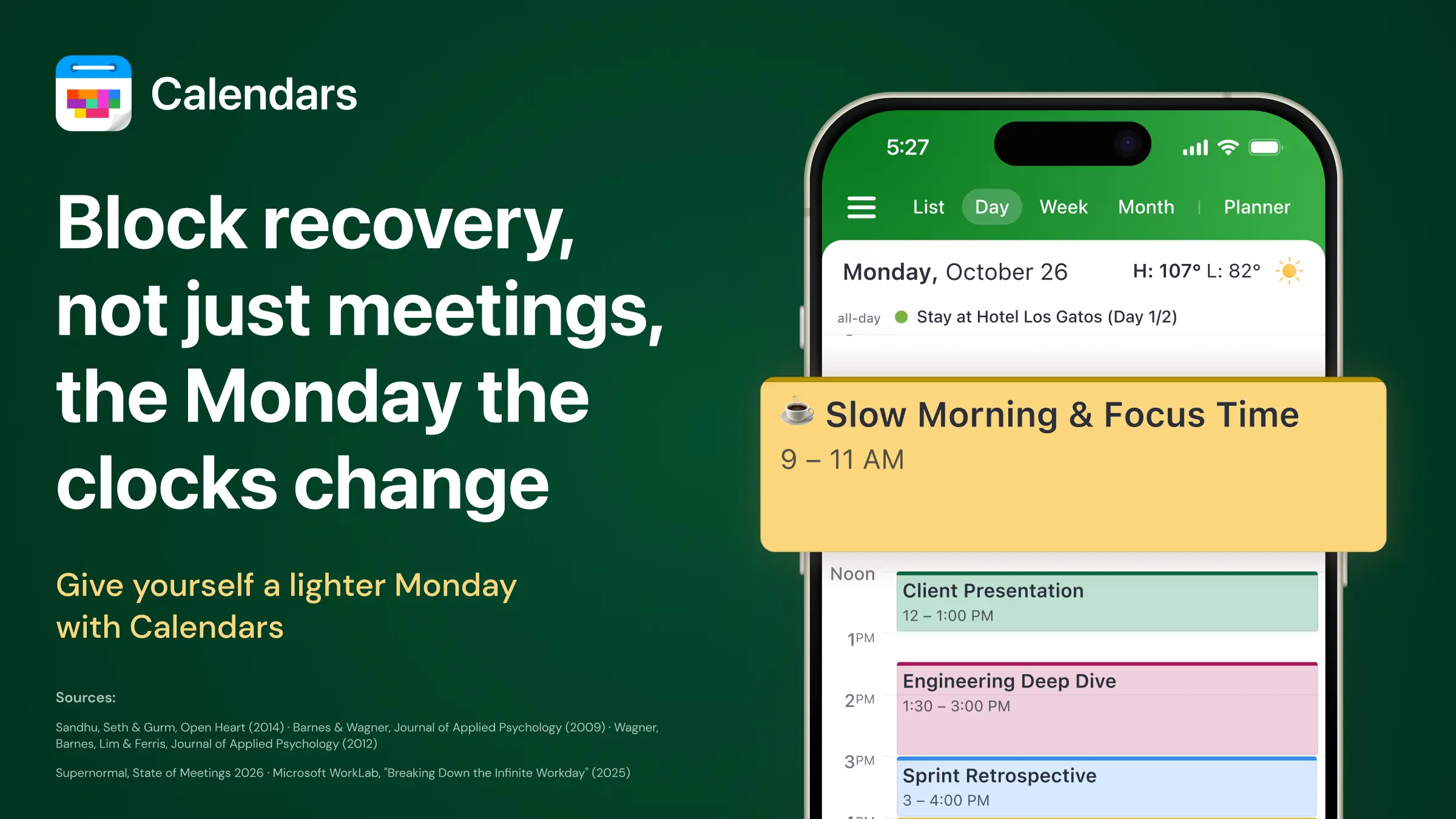
Give the Monday after clocks change some breathing room in Calendars