This project first ran in 2023, in partnership with AIN.UA. We're republishing it to mark Kulish's birthday on August 7th because some stories deserve to be told twice.
Paper doesn't last forever. Even a carefully preserved book, kept away from light, damp, and direct sunlight, has a lifespan of a few hundred years. After that, the words survive only if someone thought to copy them somewhere else first.
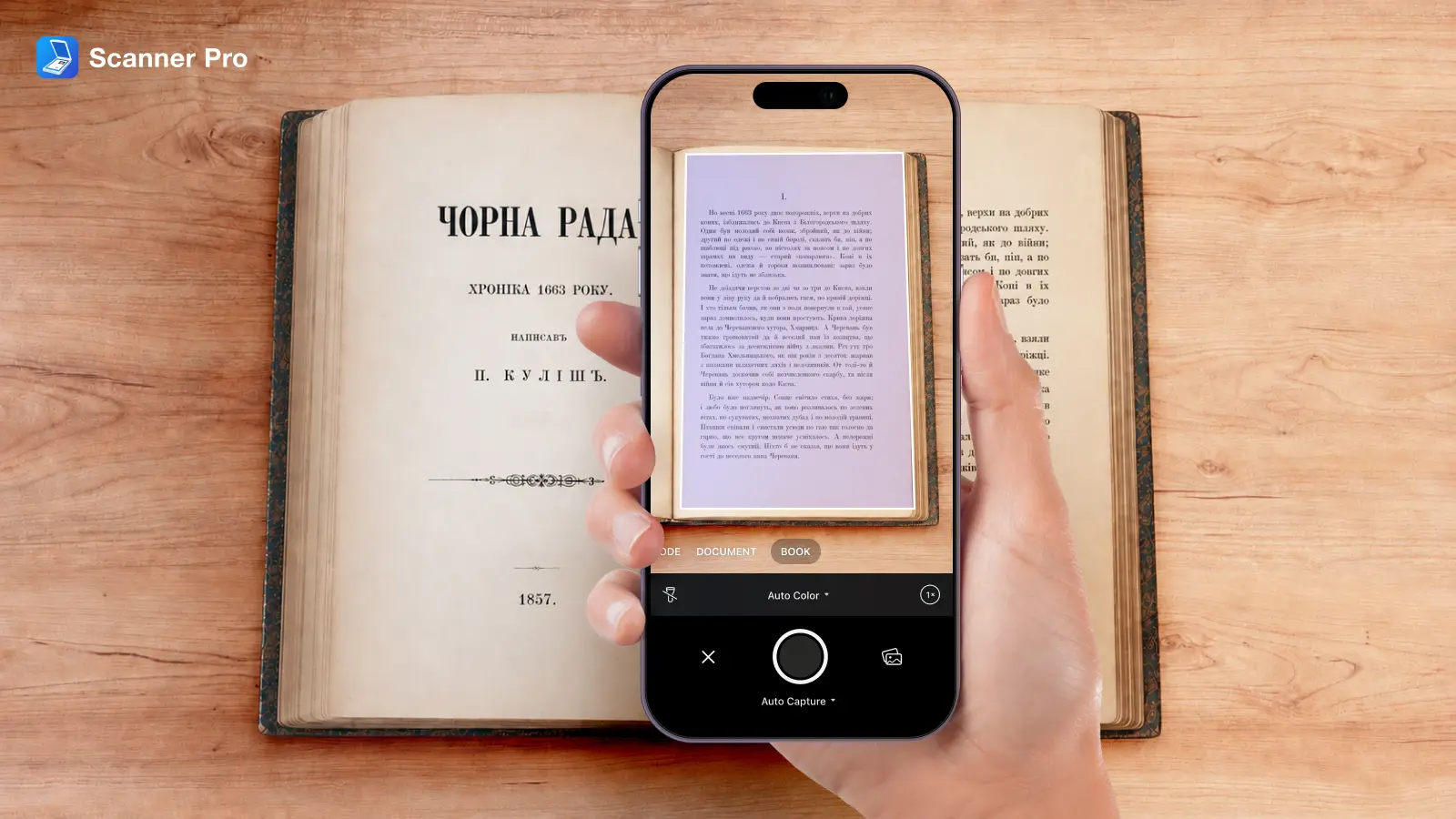
In 2023, the team at AIN.UA came to Scanner Pro with an idea. They wanted to visit the National Historical Library of Ukraine in Kyiv and use Scanner Pro to create a digital copy of the first edition of Panteleimon Kulish's Black Council. It is a 168-year-old, 428-page book published in St. Petersburg in 1857. It’s the first historical novel ever written in the Ukrainian language.
We said yes without hesitation.
Why this book matters
Kulish spent 14 years writing Black Council. He rewrote it by hand five times. He was arrested before he could publish it, sentenced to internal exile, and forbidden from writing. Russian censors picked through the manuscript before it could go to print. That it made it into print at all, in Ukrainian, not Russian, was considered something close to a miracle at the time. Literary critics have since called it the first "Walter Scott" of Ukrainian literature.
In the decades that followed, his books were seized, banned, and destroyed in their thousands across the Russian Empire. In the 1850s, Kulish wrote: "One day, the time of freedom will come for me; one day, I will escape from this terrible state." The novel survived anyway, physically, through careful preservation in libraries like the National Historical Library of Ukraine. But physical survival has always been precarious.
Ukraine knows this better than most. Due to historical language bans, huge swaths of Ukrainian-language writing were simply destroyed. The National Library of Ukraine was robbed of Ivan Fedorov's Apostle from 1574, one of only 90 copies in existence, in 2016. In 2009, nearly a thousand books were damaged in a single flood at a library in Lutsk. And since 2022, nearly 350 Ukrainian libraries have been bombed or looted.
Paper is fragile in ways that go beyond age and damp. A digital copy doesn't share any of those vulnerabilities. It doesn't burn. It doesn't flood. It doesn't need a plane ticket to access. It exists as long as there are servers and internet connections, and anyone anywhere can read it.
That's why Ukrainian libraries began digitizing their collections in the late 1990s, with the first serious attempts at rare books in the 2010s. The National Historical Library has now scanned 2,300 rare and valuable publications. Their professional desktop equipment is thorough and high-quality, but it's slow. Even with the best hardware, delicate books require such careful handling that 100 pages per hour is considered a good pace.
Mobile scanning apps are starting to change that equation.
The scan itself
Olha Andrusiv, who produced the project for AIN.UA, went to NIBU with an iPhone and scanned all 428 pages of the 1857 first edition in three hours. The book had to be treated with real care throughout: no forcing the spine flat, no pressing pages down onto a scanner bed. For a book of that age, physical contact is a risk.
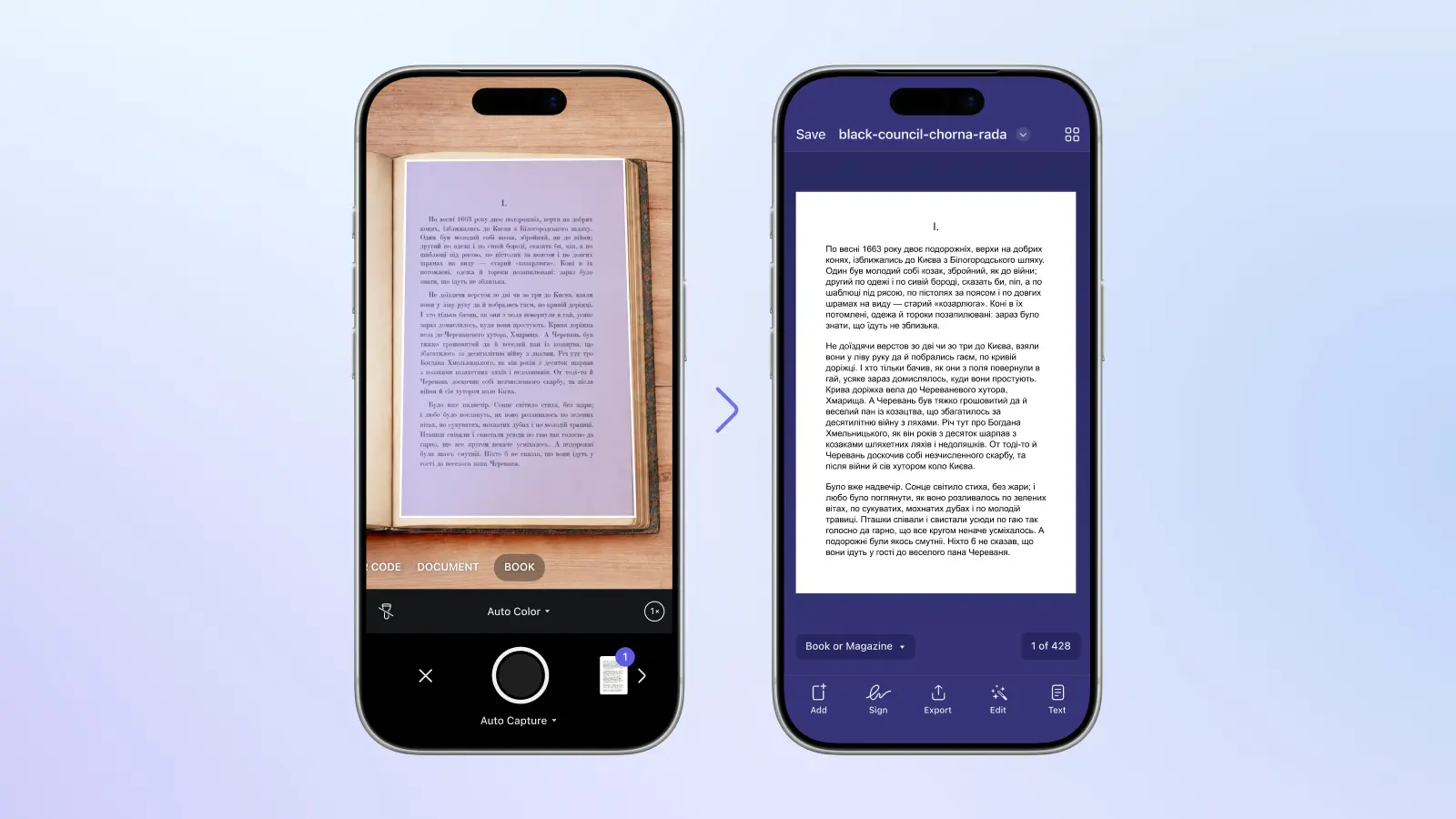
That constraint turned out to suit Scanner Pro well. The app doesn't need a document to lie perfectly flat to produce a clean result. Edge detection runs continuously at 30 frames per second, using machine learning to identify borders and correct perspective distortion in real time, including the natural curve that forms when an old book is gently held open. Auto-capture means pages can be scanned in a steady rhythm without pressing anything between shots.
If a finger drifts into frame while holding the book open, which is unavoidable with a thick, fragile volume, the AI removes it from the final image. Shadows cast by hands or the gutter are processed out automatically. There's no need for special lighting or any additional setup; ordinary room lighting is enough.
Olga Piskunovska, Support Team Lead at Readdle, offered some practical guidance for the project. For older devices syncing to cloud storage during scanning, batching into smaller groups keeps things stable. Newer iPads can handle 50 to 100 pages before saving. The app stitches all the batches back into one continuous file afterwards.
The finished scan looks almost identical to the physical book. The one thing it can't replicate, as Olha noted, is the specific smell of a 168-year-old page. Everything else from the typography to the layout and the marginalia is there.
The people who built it
Scanner Pro is a Ukrainian product, built by a team at Readdle. The app has been in the App Store since 2009 and is one of Readdle's oldest products. Most of the original engineering team is still working on it.
Ievgen Bieliakov, Product Engineering Lead at Readdle, described Scanner Pro as probably the most technically complex product he's worked on in a nearly 20-year career.
The interface is deliberately simple, but what happens underneath is not: real-time edge detection, AI models for shadow removal and finger erasure, OCR processing across 26 languages. It all runs entirely on-device, so no document data ever leaves the phone.
That last point matters especially for sensitive documents like legal, medical, and financial documents. But it turned out to matter in a different way for the NIBU project too. Something is fitting about a book that survived censorship and confiscation being digitized by a tool that processes everything locally, with nothing sent to an external server.
Andrii Denysov, R&D Lead Engineer at Readdle and a former Product Engineering Lead on Scanner Pro, put it plainly: "Scanner Pro has clearly surpassed its original idea." The app was built for business documents. It's now used for things nobody originally imagined, and the NIBU digitization project is the most meaningful example of that the team has come across.
Who uses it, and for what
The original use case for Scanner Pro was professional document management: contracts, receipts, invoices. That's still a large part of how it gets used. But the actual user base turns out to be much more varied.
About 50% of monthly users scan for personal reasons. Around 35% use it for work. The remaining 10–15% are students and teachers. Two million people use Scanner Pro every month, across the US, Germany, the UK, Canada, and many other countries.
Some of the use cases Readdle's support team has heard about over the years give a sense of how widely the app has travelled from its original brief.
A music teacher built a custom stand for an iPad, propped it up opposite a music stand, loaded Scanner Pro, and now scans entire volumes of sheet music page by page. The auto-capture feature means he doesn't press anything between pages.
A couple on holiday in Italy lost their documents; high-quality scans they'd made before leaving meant they could communicate with local authorities even without speaking the language.
A former professional photographer scans old travel photos, turns them into booklets, and sends them to family as a quiet invitation to revisit old places.
A traveler flying home to Canada forgot his ID; his scanned copy got him through the border check.
None of these are use cases that were designed for. They're things people figured out because the tool was capable and they had a problem worth solving.
Digitizing a 168-year-old Ukrainian novel is the one that has stayed with the team the longest.
Your own archive
Most of us have things worth preserving that aren't sitting in national libraries. Old family photographs. Letters. Certificates. Notebooks filled with someone's handwriting. Documents that exist in one place, in a single copy, subject to all the usual vulnerabilities of paper: fire, flood, move, time.
The chief librarian of UC Berkeley told the New York Times, 35 years ago: "Maps, manuscripts, book pages are being worn out more and more every day. All major research laboratories are sitting on a ticking time bomb." It was true then. It's still true. The difference now is that the tools for doing something about it are in everyone's pocket.
You don't need a professional scanning setup, a controlled environment, or a digitization budget. You need a phone and a few hours. Scanner Pro handles the edge detection, the perspective correction, the shadow removal, the OCR. You just need to know what's worth keeping.
The Kulish project took three hours. The book will now outlast the paper it was printed on by an unknowable margin.
How it turned out
The digital Black Council looks almost identical to the 1857 original. The typography is clear, the pages are straight, the text is searchable. The NIBU team noted that beyond books, a mobile scanner is genuinely useful for their day-to-day work too — scanning individual pages for bibliographic research, capturing illustrations, producing quick digital references without touching originals more than necessary.
Readdle's support team gets a lot of messages from Scanner Pro users that aren't complaints they're just people writing to say they love the app, often with a story attached. The ones that come from unexpected places, like a library in Kyiv, are the ones the team remembers.
Kulish wrote, in 1857, that he hoped the time of freedom would come for him. The book got out. It's still here. And now it's a searchable PDF that anyone with an internet connection can read, in a digital archive that doesn't depend on any single building staying standing.
That feels like the right ending.
Scanner Pro is free to download on iPhone, iPad, and Apple Vision Pro (iOS 18.0+).
The digitized first edition of Panteleimon Kulish's Black Council is available to download via Google Drive